Certainty: How Great Bosses Can Change Minds and Drive Innovation
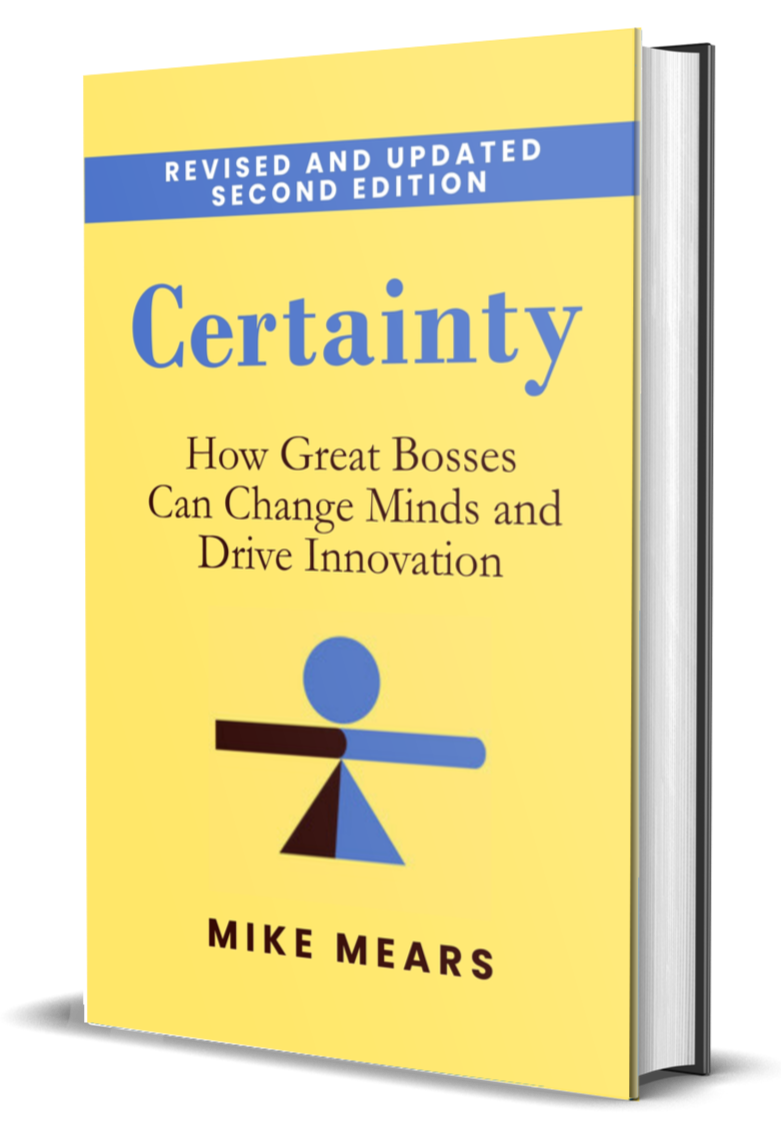
Buy the fully revised and updated second edition—available in paperback, ebook and in Kindle Unlimited.
“A compelling framework for rethinking leadership.”—Reedsy Discovery
“A distinctively original, neuroscience-based approach to management.”—Midwest Book Review
“Practical strategies to create workplaces that hum with energy and innovation.”—Amy Hagberg, Author
» SEVEN TIMES AWARD-WINNER
» Top 5 Bestseller in Business Teams
» Top 50 in Management & Leadership
Your hardest leadership problems aren’t “soft.” They’re human.
Capable leaders repeatedly encounter the same eight people problems:
Accountability,
Communication,
Engagement,
Motivation,
Dependency,
Silos and Collaboration,
Resistance to Change, and
Culture and Innovation.
Leaders are taught to rely on goals, metrics, incentives, reorganizations, and accountability systems. Those tools matter—but they rarely explain why people resist change, withhold information, avoid responsibility, lose trust, or quietly disengage.
These are human-nature problems.
Certainty shows you how to stop fighting human nature and start working with it.
Fully updated, this second edition introduces the eight Soft Issues, 13 Human Nature Levers, and the latest remarkable research on Ötzi. Drawing on cognitive science, decades of leadership research, and more than 50 years of field experience, Mike Mears provides a practical operating system for creating trust, engagement, accountability, and innovation.
INSIDE, YOU WILL LEARN HOW TO:
Create enough certainty for people to act while change is unfolding
Reduce the threat and resistance that make sensible changes fail
Use the Human Nature Levers to improve accountability, trust, communication, and execution
Replace vague leadership advice with practical, repeatable habits
Diagnose the people problems that dashboards, reorganizations, and incentives miss
Build a workplace where people speak candidly, take responsibility, collaborate, and innovate
Certainty is written for frontline managers, experienced executives, CEOs, coaches, consultants, and leadership-development professionals who want practical tools instead of platitudes.
Great leadership isn’t mysterious. It is human nature—and it can be reverse-engineered.
Ready to solve the leadership problem keeping you up at night? Order your copy of Certainty now.
Reading Certainty? Take the map with you.
The Periodic Table of Leadership Elements is the one-page companion to the book—the full set of 118 elements that make up a great leader, free.
A revolutionary and indispensable guide to dramatically increase trust, engagement, and innovation in the people you lead by using practical, brain-friendly tools in habitual, consistent ways.
Great leaders draw out the best of human nature.
The dilemma
Evolutionary psychologists tell us that our minds have not altered much since the Stone Age. Our brains are survival machines, programmed to fear change. So, what are managers to do when getting others to change is a major part of their job? When author Mike Mears was the CIA’s Chief of Human Resources, he was posed with this very question.
The solution
In Certainty: How Great Bosses Can Change Minds and Drive Innovation, Mears offers the answer: understand human nature. Work with it rather than pushing against it. Mears draws on neuroscience and psychology—plus compelling stories from his career—to offer practical leadership advice, including:
Entertaining, science-backed explanations of how our brains think and how our primitive brains are colliding with the demands of the modern workplace
Actionable feedback, change management, and delegation tools to build an environment of certainty rather than of fear
Visual prompts to overcome innate change resistance in yourself and others
Mental prompts to boost leadership insight and inclusion
The results
You want loyalty, trust, and great performance from your team. We all do. With Mears’ guidance, you can identify the limitations and strengths of the human mind and then create positive change by applying that understanding in the workplace.
AWARD-WINNING AND BESTSELLING







HIGHLY REGARDED
“If you are in the process of reengineering your organization, the concepts and suggestions detailed in Mike’s book will prove to be indispensable.
The framework and tips presented in this book will help you avoid many of the common and often catastrophic mistakes that change agents make.
Providing certainty to the troops is the key to a successful journey.
Mike Mears is the REAL DEAL.
He deeply understands the theory of leadership and is a master practitioner.”
—Jim Gosler, senior fellow, Johns Hopkins University Applied Physics Laboratory, and former director of CIA Clandestine Information Technology Office
“Leadership is a team sport.
It’s about recognizing and magnifying people’s talents in ways that overcome tribal barriers and self-doubts within an organization.
I strongly recommend Mike Mears’s book because it offers actionable insights and tools to overcome those hidden barriers and doubts.
It’s a road map for driving transformative change in any organization.”
—C. Robert Henrikson, retired chief executive officer and chairman of MetLife
FIVE-STAR REVIEWS

Boasting a career background in the CIA and the US Army, alongside years of experience managing private equity funds as a senior vice president at GE Investments, Mike Mears brings an all-in-one guide that draws from basic human nature and behavior to provide innovative approaches and tools to great leadership.
In Certainty, Mears examines how our primitive minds operate and affect our behavior in today's office environments, reveals how uncertainty blocks progress, and offers solutions to foster productive office environments where people love to work.
Additionally, you will learn about why our neural wiring tends to focus more on threats, auto-brain and how it resists change, the many benefits of social bonding, intrinsic and extrinsic rewards, cultivating a positive and supportive work environment, cognitive biases, mistrust, mastering healthy habits, building trust, deriving employee engagement via storytelling, and much more.
Using stories, personal anecdotes, and examples, Mike Mears shows readers how to avoid the pitfalls of modern workplaces and overcome the limitations of the primitive brain to lead well-oiled functioning teams with employees who feel fulfilled and rewarded.
Certainty is for both aspiring and veteran leaders. It will help them cultivate a growth mindset that negates fear and self-doubt and discover new insights drawn from psychology and human behavior that can be applied in modern workplaces.
Furthermore, you will find prompts and exercises to use the lessons you've learned from this book in your everyday life. Mears has a meticulous eye for detail regarding how the content is presented. It makes the book not only accessible but also thoroughly engaging to read.
I found it very informative, educational, and inspirational. Highly recommended!
~ Pikasho Deka for Readers' Favorite
Mike Mears’ Certainty: How Great Bosses Can Change Minds and Drive Innovation takes a deep dive into the human mind and how our survival instincts shape workplace behavior.
The book is built around the idea that humans crave certainty, and uncertainty often triggers fear, resistance, and poor decision-making. Mears explores concepts like the "auto-brain," which governs instincts and emotions, and the "focused-brain," which helps us control those impulses. Through engaging anecdotes—some from his time in intelligence—he presents practical leadership strategies to build trust, inspire teams, and drive innovation.
At its core, the book argues that great leaders don’t just manage—they create a sense of psychological safety that allows people to thrive.
One of the things I really appreciated about Certainty is how it strips leadership down to the basics of human nature. It’s not just about motivational speeches or company mission statements; it’s about how our brains are wired. Mears breaks down how we spend most of our day running on instinct, often without realizing it.
His discussion on how humans resist change not out of stubbornness but because our brains are wired to see it as a threat felt like a lightbulb moment. He explains that the key to leading people through change isn’t brute force but creating a sense of security. The simplicity of that insight hit hard.
One of the book’s strengths is its clear and consistent message about how uncertainty triggers fear, reinforcing the importance of creating psychological safety. Mears emphasizes this idea throughout, ensuring it sticks with the reader. His anecdotes from intelligence and corporate leadership are captivating, offering unique insights from high-stakes environments. I appreciated the inclusion of case studies from everyday workplaces to showcase how these concepts apply across a broader range of industries.
One of my favorite sections was the one on "Mental Prompts," which provides easy, actionable ways to create a culture of certainty. The “Vision Prompts” help clarify expectations, the “Inclusion Prompts” tap into our social bonding instincts, and the “Insight Prompts” encourage creative problem-solving. Mears makes a compelling case that small, consistent behaviors like genuine recognition or making sure everyone feels included can have a massive impact on a team. The example of CIA officer Renee, who created a high-performing unit in a war zone by focusing on trust and inclusion, was powerful.
Certainty: How Great Bosses Can Change Minds and Drive Innovation is an insightful, engaging read that makes leadership feel less like a skill you have to master and more like a mindset you can adopt. If you’re a leader (or aspiring to be one) and want to understand what truly motivates people, this book is worth your time. It’s particularly great for managers in high-pressure environments, but honestly, anyone who works with people will find something useful here.
If you’ve ever been frustrated by resistance to change or struggled to inspire a team, this book will give you practical ways to flip that script. Highly recommended.
~ Literary Titan
Become the leader everyone wants to follow
In Certainty, Mike Mears, former CIA Chief of Human Capital and founder of the CIA Leadership Academy, reveals a revolutionary approach to leadership.
Blending cutting-edge cognitive science with captivating stories from his time in the CIA and private sector, Mears provides a practical and entertaining guide to leadership success.
Discover how to reverse-engineer human nature to understand what drives people and align your leadership approach for effortless results.
Buy Certainty from Amazon now.
Leadership Elements

Leadership Elements: A Guide to Building Trust
Leadership is composed of many simple yet powerful elements. In Leadership Elements, I describe these elements and how to apply them in all types of organizations to become an effective leader, improve your organization’s performance, and motivate employees.
Three more books are coming.
Between now and 2028 I'm publishing three more books—from practical nonfiction to a novel—all in service of one idea: leadership that works with human nature instead of against it. Newsletter subscribers hear first and get launch-week pricing.
100 FAQs on Brain-Friendly Leadership
Human Nature Levers, Behavioral Triggers, Certainty, and the Human Nature Framework
The Big Picture
1. What is Certainty: How Great Bosses Can Change Minds and Drive Innovation about?
It's a book about why traditional management tools—orders, incentives, dashboards, town halls—so often fail to change behavior, and what actually works instead. The short answer: leadership has to work with human nature, not against it. The book builds a practical toolkit for doing that, grounded in brain science and tested across government and private-sector organizations.
2. What's the 'Spymaster's Dilemma' that started all this?
Early in my CIA career, one of the most powerful people in the intelligence world called me into his office and asked, 'Mike, why is it when I pull the levers, nothing happens?' I couldn't give him a good answer that day, and the question haunted me for twenty years. It turned out the levers he meant—pay, structure, policy—weren't broken. They were simply aimed at the wrong part of the brain.
3. What do you mean by 'Behavioral Triggers'?
Behavioral Triggers are simple, repeatable leadership actions or questions designed to produce positive behavior change by working with human nature instead of pushing against it. Instead of forcing behavior through pressure or instruction, they change the conditions the brain is responding to, and better behavior follows naturally.
4. Didn't you used to call them something else?
Yes. The concept started as 'Mental Prompts' in early drafts of the book, then became 'Behavioral Triggers' because it's more precise and less abstract. In the second edition I've used 'Human Nature Levers' as an umbrella term for the same set of 13 tools. The underlying idea hasn't changed—only the label has sharpened.
5. What's the difference between Behavioral Triggers and Human Nature Levers?
They're the same set of tools described two different ways for two different audiences. 'Behavioral Triggers' is the core framework term I use on the LeadCultureChange.com app. 'Human Nature Levers' is the term I use in the second edition and in live workshops with CEOs, where it functions as a friendlier umbrella label for the same 13 techniques.
6. What is 'certainty' in your framework, and why is it the master lever?
Certainty is the psychological state where the brain feels safe enough to open up—to think clearly, take initiative, and engage instead of just protect itself. It's the thing every other lever the Spymaster tried to pull was actually meant to produce, but none of them produced it directly. Certainty is what you get when Safety and Trust are both present.
7. Who is this framework for?
Everyone in the management chain, from frontline supervisor to CEO, plus executive coaches, leadership enthusiasts, and people considering a move into management. The techniques are universal because they're based on how the human brain works, not on a particular org chart level—though some tools matter more at the top and some more on the front line.
8. Is this a public-sector framework, a private-sector framework, or both?
Both. I built and tested it across a CIA career, a GE executive career, and years of consulting since, in organizations ranging from government agencies to private companies of every size. Human nature doesn't change based on your sector—it's the same brain in a cubicle, a factory, or a classified briefing room.
9. What makes your approach different from other leadership books?
Most leadership advice starts with what the organization needs and tries to get people to comply. This framework starts with what the brain needs and designs conditions that make good behavior the natural outcome. It's also built from measured, real-world data—including a good-boss/bad-boss study I ran inside the CIA—rather than theory alone.
10. Why does Ötzi the Iceman show up throughout your work?
Ötzi, the 5,300-year-old man discovered frozen in the Alps, had essentially the same brain wiring we carry today. He's the fastest way to make a simple point real: the mind that kept him alive on a glacier is the same mind sitting in your team's cubicles, still scanning for threats, still resisting change, still needing safety before it will risk anything new.
The Science Behind It: Why Human Nature Fights Back
11. What's the 'auto-brain,' and how is it different from the 'focused brain'?
The auto-brain is fast, automatic, emotional, and runs on instinct—it's in charge far more often than we like to admit. The focused brain is slower, deliberate, and logical, but it tires quickly and gets sidelined under stress. Most leadership tools are aimed at the focused brain. Most employee behavior is driven by the auto-brain.
12. Why does the auto-brain run the show more than we think?
Because it's built for speed and survival, and speed wins when there's any hint of threat. We like to believe 'we think, therefore we're logical,' but most of the time we aren't—the auto-brain has already reacted before the focused brain even gets a vote.
13. What is fight-flight-freeze, and why does it matter at work?
It's the automatic cascade your body triggers when it senses danger—heart rate up, higher-order thinking shelved, focus narrowed to the immediate threat. It evolved for physical dangers like Ötzi's wolves. The problem is your brain can't tell the difference between a real predator and a curt email from a colleague—office danger feels like actual danger.
14. Why does an email from a coworker sometimes feel like a physical threat?
Because the same ancient alarm system fires either way. Adrenaline and cortisol flood your system, but you can't run from the email or fight it, so those stress chemicals have nowhere to go. Multiply that by a dozen similar moments a day and you get chronic anxiety, hyperreactivity, and burnout.
15. Why haven't our brains caught up with the modern workplace?
Because meaningful brain evolution mostly stopped tens of thousands of years ago, while our environment has changed almost entirely in the last century. We're running Stone Age hardware on twenty-first-century software, and that mismatch is where most leadership problems are born.
16. What is 'evolutionary mismatch'?
It's the gap between the conditions our brains were built for and the conditions we actually live and work in now. Ötzi's world was predictable, physical, and tribal; the modern workplace is unpredictable, digital, and full of strangers. The wiring hasn't updated to match.
17. What role do cortisol, dopamine, and oxytocin play in leadership?
Cortisol is the stress hormone that floods the brain under perceived threat and shuts down higher-order thinking. Dopamine is the learning and reward chemical—it says 'do that again.' Oxytocin is the bonding chemical that signals safety and belonging. Good leadership behavior lowers cortisol and raises dopamine and oxytocin; bad leadership does the opposite.
18. Why can't you talk someone out of resistance to change?
Because resistance isn't a logic problem—it's a threat response. You can't reason someone out of a feeling they weren't reasoned into in the first place. That's why change programs built entirely on communicating the rationale so often stall: they're aimed at the focused brain while the auto-brain quietly runs the resistance underneath.
19. What is the Dunning-Kruger effect, and why does it matter for leadership development?
It's the well-documented tendency for people who are weakest at something to overestimate their ability at it. In my CIA research, the best bosses wanted to get even better, while the worst ones thought they were already good enough. It's one reason leadership training so often fails—you can't improve someone who's convinced they don't need to.
20. Why do smart, well-intentioned managers still get bad results?
Because intelligence and good intentions live in the focused brain, and most of the behavior they're trying to change lives in the auto-brain. A brilliant strategy, explained perfectly, can still be rejected before its logic is even considered if it triggers a threat response first.
The Four Conditions: Safety, Trust, Clarity, Challenge
21. What are the Four Leadership Behaviors, or Four Conditions?
Safety, Trust, Clarity, and Challenge. They're the four pillars the auto-brain needs to perform at its best. Every Behavioral Trigger/Human Nature Lever in the toolkit addresses one or more of them, and when all four are present consistently, you get a high-performance culture.
22. What does 'Safety' mean in your framework?
It's the conviction that it's genuinely okay to speak honestly, try something new, or make a mistake without being punished for it. Safety isn't comfort, and it isn't the absence of hard work—it's the psychological precondition that has to exist before anything else on this list can happen.
23. What does 'Trust' mean, and how is it built?
Trust turns a momentary feeling of safety into a reliable expectation. You build it through consistency—doing what you said you'd do, showing up the same way on a bad day as a good one, following through on small commitments before big ones. The brain is a pattern detector, and the pattern it's watching for is predictability.
24. What does 'Clarity' mean, and why is ambiguity so costly?
Clarity means people know what's expected, what success looks like, and how their work connects to something bigger. Ambiguity signals danger to the auto-brain, so the less clear you are, the more anxious and defensive your team becomes—even if nothing is actually wrong.
25. What does 'Challenge' mean, and why can't you have Safety without it?
Challenge is work that stretches capability and requires real thinking. It's the condition leaders most often sacrifice in the name of the other three, protecting people from difficulty instead of preparing them for it. But humans are wired for mastery—without genuine challenge, engagement decays even in a perfectly safe environment.
26. What's the formula 'Safety + Trust = Certainty'?
When people feel safe and can rely on consistent behavior from their leader, the brain opens up—that combination is what produces psychological certainty, the state where people stop protecting themselves and start contributing.
27. What's the formula 'Clarity + Challenge = Purpose'?
When people know exactly what's expected and are given work that genuinely stretches them, they understand why it matters. That combination produces purpose—the sense that the effort connects to something meaningful, not just busywork.
28. What happens when one of the four conditions is missing?
One or more of the eight soft issues shows up—broken accountability, shallow communication, low engagement, weak motivation, dependency, silos, resistance to change, or a stalled culture. Each of those issues traces back to a gap in Safety, Trust, Clarity, or Challenge.
The Toolkit: Behavioral Triggers One by One
29. What exactly qualifies as a 'true' Behavioral Trigger?
Four things: it has to be empirically grounded in real research, psychologically aligned with genuine human needs like belonging and autonomy, neuroscience-informed in how it actually affects the brain, and battle-tested in real organizations—not just a nice theory.
30. What are Vision Prompts?
Tools built on the principle that seeing is believing. They produce clarity by helping people visualize outcomes, expectations, or the bigger picture rather than just hearing about them described in the abstract.
31. What's the difference between the two Vision Prompts?
Sight Prompts use literal visual tools—images, diagrams, physical demonstrations—to make an idea concrete. Visioning Prompts ask people to mentally picture a future state or outcome. Both work through the same principle: the brain trusts what it can see, literally or in its imagination, more than what it merely hears.
32. What are Inclusion Prompts (Full Inclusion)?
Techniques that engage people's minds, not just their hands—asking genuine input from people who aren't usually asked, then actually listening and acting on it. Being consulted satisfies a deep status need in the social brain; being left out registers as a form of social pain.
33. What are Insight Prompts, and why do they work better than direct instruction?
An Insight Prompt is a leader's courteous question or assignment that gives someone 'mental homework'—a deadline, time to reflect, and a follow-up. Because the person arrives at the idea themselves, the brain experiences it as their own insight rather than someone else's order, which produces a genuine sense of ownership and certainty.
34. What is Soft Accountability?
A form of accountability built on predictability, shared expectations, support, and ownership rather than blame or micromanagement. It activates certainty, protects people's sense of status, and reinforces autonomy—all without the fear that shuts down honest reporting.
35. What are Leadership Behaviors (the specific Trigger, not the umbrella term)?
The simple, repeatable moment-to-moment actions that set the emotional weather of a room before a word is spoken—staying calm under pressure, responding to bad news without blame, making it genuinely safe to disagree, addressing problems early, and treating people with consistent respect regardless of role.
36. What is a Check-In, and how is it different from a status meeting?
A Check-In is a short, regular, two-way conversation meant to ask, listen, and support—not to extract a status update. Questions like 'What's getting in your way?' or 'What do you need from me this week?' work because the frequency, not the length, is what builds trust over time.
37. What is Brain-Friendly Feedback?
Feedback that's future-focused (pointing to what could be different, not dwelling on what went wrong), permission-based (asking before you give it), and delivered with a tone of genuine care. It preserves identity while still being honest about impact, which keeps the auto-brain from shutting down defensively.
38. What is Weekly Praise, and why the 8-to-1 ratio?
Specific, sincere, and timely recognition that releases dopamine and oxytocin—reinforcing good behavior and building belonging. My research points to roughly eight positive comments for every corrective one as the ratio needed to keep people in a receptive, growth-oriented state, and most leaders fall well short of it.
39. What is a Leadership Review?
A scheduled, positive, structured conversation focused entirely on how a leader and team are leading and performing—not deliverables, deadlines, or HR issues. Done right, it's never a gotcha, and it lets influence cascade down the chain when a leader asks their direct reports to run the same kind of review with their own teams.
40. What is Leadership Reflection?
A weekly practice of asking yourself three questions: who needs acknowledgment this week, who needs support you haven't given yet, and what you did this week that worked against the conditions you're trying to build. It's the discipline that keeps the other tools from decaying into empty habit.
41. What is Habitual Process?
The deliberate design of recurring structures—a weekly check-in, praise at the start of every meeting, a quarterly leadership review—that embed good behaviors into routine before willpower is required. You don't rise to your intentions; you fall to your habits, so design the habits first.
42. What is Precision Delegation?
Matching a challenging piece of work to a specific person based on their strengths or developmental needs, with the explicit intent to develop them, not just get the task done. Defining the boundary of their authority up front—decide alone, flag, or get sign-off—is what makes it stick instead of bouncing back unfinished.
43. What is Scientific Selection?
Choosing people for roles and responsibilities based on evidence about their actual strengths and fit, rather than convenience or who happens to be available. It ties into the broader idea that trust is built through consistency, and consistent, well-matched selection decisions build that trust over time.
44. What are Primal Communication Hacks?
A short inventory of habits that work with the auto-brain instead of against it: assume the best, watch for emotion and stay calm, create space to respond rather than react, ask power questions, repeat key messages in different formats, tell stories, and create urgency only when it's genuinely needed.
The Eight Soft Issues
45. What are the 'eight soft issues'?
Accountability, communication, engagement, motivation, dependency, silos and collaboration, resistance to change, and culture and innovation. They're the recurring, people-centered problems that traditional management tools consistently fail to fix.
46. Why do soft issues keep coming back no matter how many initiatives you launch?
Because most initiatives target the focused brain—logic, incentives, policy—while soft issues live in the auto-brain. Until the underlying condition (Safety, Trust, Clarity, or Challenge) is actually addressed, the same issue resurfaces in a new form.
47. What's the root cause behind all eight soft issues?
The auto-brain operating in threat mode instead of reward mode. Whatever the surface symptom—broken accountability, silence, low morale—the underlying condition is almost always missing psychological safety.
48. Why does accountability collapse under too much pressure?
Because heavier metrics, sharper consequences, and constant measurement push people into self-protection—managing optics, hiding problems, gaming numbers—instead of ownership. Pressure alone produces motion, not truth.
49. Why does silence get mistaken for alignment?
Because silence in a meeting can mean agreement, but it can just as easily mean confusion, fatigue, fear of being labeled difficult, or political caution. Leaders often walk away believing they've achieved alignment when they've only achieved suppression.
50. Why do silos form, and can you really eliminate them?
Silos form because the brain naturally extends more trust and status to its own in-group—that tribal wiring can't be erased, but it can be redirected. Cross-functional work, visible credit given across department lines, and rotating assignments rewire who counts as 'in-group.'
51. Why do 70% of change initiatives fail?
Because most are designed to persuade the focused brain through logic and a clear rationale, while the auto-brain runs an unexamined threat response the whole time. Reflection on what people fear and need has to come before the change itself, not after.
52. What's the 'tangibility bias,' and why does it sabotage culture change?
It's the tendency to focus on what's visible and measurable—dashboards, plans, KPIs—while culture, trust, and inclusion don't show up neatly in a spreadsheet, so they get quietly deprioritized even when leaders say they matter.
53. Is culture something you can change directly?
Not by rewriting the values statement or hosting a town hall. Culture is what people do automatically, and it only shifts when a handful of Behavioral Triggers/Human Nature Levers get applied consistently enough, for long enough, that new behavior becomes habitual.
54. What's the connection between innovation and psychological safety?
Every creative idea starts as something that might be wrong or get rejected, so the brain won't offer it up unless it's confident the environment is safe. Genuinely innovative organizations share leaders who ask more than they answer and who visibly celebrate the good try that didn't work.
Soft Accountability
55. Isn't accountability supposed to involve consequences?
Traditional accountability leans on blame, judgment, and consequence. Soft Accountability isn't the absence of consequence—it's predictability, shared expectations, and follow-through built on trust rather than fear, which produces more reliable follow-through, not less.
56. What's the difference between Traditional and Soft Accountability?
Traditional Accountability relies on blame, judgment, micromanagement, and compliance. Soft Accountability relies on predictability, shared expectations, mutual support, ownership, and reliability. Same goal—people doing what they said they'd do—achieved through very different means.
57. What three brain responses does Soft Accountability activate?
Certainty ('I know what's expected'), status safety ('I won't be embarrassed or blamed'), and autonomy ('I own my solution and delivery'). Together they let people commit without triggering a threat response.
58. How do you start a conversation about redefining accountability with a team?
Spend about five minutes in an ordinary staff meeting brainstorming what 'accountability' means to different people. You'll get a wide range of answers—blame, clarity, micromanaging—which opens the door to reframing it as clarity and follow-through rather than punishment.
59. What are the costs of having no real accountability?
Projects quietly fade for lack of clear ownership, the same work gets redone because expectations were never clear, and frustration builds when commitments go unmet but no one says anything. Left unaddressed, it generates more meetings, more stress, and more rework.
60. What three things should every employee be able to state about their commitments?
What they will do, how you'll know it's done, and when they'll deliver it. If someone can answer all three after a short conversation with their manager, accountability is already in place without a heavy system around it.
61. Doesn't 'soft' accountability risk letting people off the hook?
No—it front-loads clarity instead of back-loading blame. People are actually more reliable when they're clear on expectations and feel supported, because they experience the commitment as trust rather than control.
62. How does empowerment without accountability go wrong?
Gallup's research found that empowerment alone produces mixed results—think of it as an unguided rocket. High-performing organizations pair empowerment with the right kind of accountability, which acts as the fins and guidance system, not a brake.
Why Smart CEOs Trip Over Human Nature
63. Why do smart CEOs keep tripping over human nature?
Not because they lack intelligence or ambition, but because many leadership systems start with what the organization needs rather than what the human brain needs. That single inversion—organization-first instead of brain-first—explains most of the recurring frustration in the C-suite.
64. What's the biggest mistake CEOs make when rolling out a new strategy?
Assuming people will process the logic before they process the threat. Employees ask, often unconsciously, whether the change is safe for them before they evaluate whether it's smart for the company—so uncertainty has to be reduced before the business case is even made.
65. How does pushing accountability too hard backfire?
More dashboards, scorecards, and consequences produce activity, but they also push people into self-protection—managing optics and hiding problems rather than genuinely owning outcomes. The organization ends up with more motion and less truth.
66. What's wrong with over-relying on authority?
People want leadership, but they also want autonomy and dignity. Lean too hard on command-and-execute behavior and you get compliance without commitment—people follow instructions but withhold the discretionary effort that actually drives performance.
67. Why is 'no objections' not the same as agreement?
Silence in hierarchical environments often signals confusion, fatigue, or fear of being labeled difficult rather than genuine consensus. Leaders who mistake it for agreement are usually watching suppression, not alignment.
68. Why do town halls and cascade memos often fail to actually communicate?
Because messages lose emotion, urgency, and credibility as they pass down through management layers—a sincere message from the top can arrive three layers down as bland instruction. Small-group, human-scale communication travels far better than polished broadcasts.
69. How should CEOs design change instead of forcing it?
Use pilots before enterprise rollouts, volunteers before mandates, quick wins before major asks, and employee input before the design is finalized. People rarely oppose change in the abstract—they oppose becoming vulnerable inside it, so change should be designed to feel survivable.
70. What's the CEO Mirror Test?
A short set of self-check questions: Do our systems create ownership or fear? Is silence being mistaken for support? Would bad news reach me quickly? Are we asking people to change faster than we're reducing their uncertainty? The honest answers are often more revealing than any engagement survey.
71. Why do 30–50% of new CEOs fail in their first 18 months?
Research consistently points to cultural misfit, behavioral blind spots like poor change management or tolerance of low performers, misaligned stakeholder expectations, and an onboarding process that hands over a laptop and calls it integration. Very rarely is it a lack of technical competence.
72. What's the difference between a 'controller' leader and a 'designer of conditions' leader?
A controller tries to manage outcomes directly through instruction and oversight. A designer of conditions builds an environment—safe enough to speak up, clear enough to act, valued enough to contribute, challenged enough to grow—and lets performance emerge from it rather than forcing it.
What Business School Doesn't Teach
73. What do MBA programs teach well?
How organizations work—capital allocation, incentive design, market analysis, operations, and strategy. Team dynamics coursework is also relatively strong, covering things like team development stages and decision-making biases.
74. What's the biggest gap in MBA education?
Sustained instruction in applied psychology—how fear, identity, status, and belonging actually shape day-to-day behavior. Graduates often know what to do strategically without knowing how to move real human systems to act on it.
75. Why do incentive systems often backfire?
Because they're built on the assumption that people are mostly rational actors who respond predictably to rewards. In practice, incentives can crowd out intrinsic motivation, encourage risk-avoidance over innovation, and shift attention from purpose to self-protection.
76. Why isn't psychological safety trained as a leadership behavior in most programs?
Because it's usually mentioned as a concept rather than taught as something a leader actively does moment to moment—how tone and timing silence ideas, how authority itself triggers a threat response, how small signals of inclusion or exclusion compound daily.
77. How is change management usually taught, and why is that incomplete?
As a process: build a case, communicate the vision, address resistance, sequence initiatives. Resistance gets framed as an obstacle to overcome rather than what it actually is—a biological response to uncertainty and threatened status.
78. What's the most important instrument a leader has that MBA programs ignore?
Their own nervous system. People take emotional cues from whoever's in authority—calm creates clarity, certainty creates trust, and anxiety spreads faster than any strategy document. Executives are trained to think clearly under pressure, but rarely trained to help others do the same.
Communication in the Always-On Era
79. What's wrong with an 'open door' policy in the smartphone era?
The literal door has been replaced by a digital one—texting—and it never closes. What was meant to signal approachability instead produces confusion, exhaustion, and resentment on both sides, because access has quietly been mistaken for connection.
80. Why does constant availability actually undermine leadership?
Because every notification steals focus, and every attention switch forces the brain to reboot, draining energy and clarity. Leaders who are always reachable end up more distracted, more reactive, and less strategic—the opposite of what an open-door policy was supposed to achieve.
81. How do you build a healthy texting policy for a team?
Make it collaborative, not top-down. Share the reasoning with your team, then discuss it openly and agree together on boundaries—emergencies only, quiet hours, no private triangulation—and put those norms in writing so they're fair and clear to everyone.
82. Should leaders ever use text messages for feedback or correction?
No. Texts should stay positive and brief. Correction and critique need the nuance, tone, and two-way exchange that only a real conversation can provide—something a text strips away almost entirely.
83. What's the real difference between being reachable and being present?
Reachability is about access—you can be pinged anytime. Presence is about attention—you're actually there, undistracted, when it counts. The best leaders aren't endlessly available; they're meaningfully present, and they protect that distinction deliberately.
Applying This in Government and Other High-Stakes Organizations
84. Does your framework apply to government agencies as well as private companies?
Yes—I built it working inside both worlds, at the CIA and at GE, and the underlying wiring doesn't change based on sector. What changes is the specific pressures: government organizations answer to stakeholders more focused on mistake-free execution than to shareholders focused on results.
85. What is 'elitism,' and why does it create blind spots in high-performing organizations?
A healthy sense of identity can curdle into elitism, where a group's tried-and-true methodology hardens from tradecraft into dogma, and eventually into something close to religion. Elite groups then resist outside ideas and management training, believing they already hold the answers within.
86. What are 'white spaces,' and why are they dangerous?
The gaps between or inside organizational charters—problems nobody owns and opportunities nobody takes. They form where structural rigidity, human resistance to change, and outdated processes intersect, and in high-stakes fields they can represent serious blind spots.
87. Why do large-scale reorganizations rarely fix a broken culture?
Because there's no documented case of a successful transformation resulting simply from moving organizational boxes around. People, culture, structure, and process are tightly interwoven, and changing only the structure leaves the deeper inertia untouched.
88. What's the lesson from the Westinghouse Air Brake vs. Toyota comparison?
A hierarchical, rule-bound structure fit the simple, repetitive assembly work of a century ago. Toyota, doing similar work a hundred years later, flattened its structure and replaced rigid rules with principles like 'ask why five times' and 'seek the wisdom of ten people rather than the knowledge of one'—proof that structure has to fit the workforce and era, not just the mission.
89. Why is a 'revolution in structure' usually the wrong reform strategy?
Because most failed transformations, public and private, targeted structure or doctrine while leaving culture and process—the organization's real operating DNA—largely untouched. Structural change alone consistently underperforms change that also reaches the human systems underneath it.
Getting Started
90. Where should a manager start if this all feels overwhelming?
Pick one soft issue you're most urgently facing, then reach for the one or two Behavioral Triggers/Human Nature Levers that map most directly to it. You don't need to master the whole toolkit at once—consistency with a few tools beats a scattered attempt at all 13.
91. What's the Thirty-Minute Weekly Action Plan?
A five-step routine: review the Behavioral Triggers/Human Nature Levers, plot where you currently stand, reflect on your specific situation, decide what to improve, and fill out a simple action plan. Thirty focused minutes a week is enough to meaningfully shift how you lead.
92. Do I need a budget or a training program to use this framework?
No. These are small, repeatable actions—a five-minute check-in, a specific piece of praise, a well-framed question—not a costly transformation initiative. That's part of the point: culture-shaping tools that don't require a program or a committee.
93. Can frontline managers use these tools, or is this just for executives?
Both, and that's deliberate. The Behavioral Triggers/Human Nature Levers work the same way at every level because they're addressing universal brain wiring, not a particular rung on the org chart—though some tools, like Leadership Reviews, matter more the higher up you go.
94. How long does culture change actually take?
Longer than a memo or a town hall, and it happens through repetition, not announcement. The consistent daily practice of a few brain-friendly behaviors compounds over months and years into a self-sustaining culture—one that no longer needs to be actively managed.
95. What's the fastest Behavioral Trigger/Human Nature Lever to start using tomorrow?
The Check-In. A five-minute, two-way conversation asking 'What's getting in your way?' or 'What do you need from me this week?' costs nothing, requires no approval, and starts lowering stress and building trust from the very first use.
96. How do I know if a soft issue in my organization stems from a missing condition?
Trace the symptom back. Broken accountability and shallow communication usually point to missing Safety or Trust. Dependency and resistance to change usually point to missing Clarity. Low motivation and stalled innovation usually point to missing Challenge.
97. Can Behavioral Triggers/Human Nature Levers work in reverse—can employees use them on their bosses?
Yes. Nothing about the underlying brain wiring is directional—you can create safety for your own manager, challenge upward, or offer clarity to a boss who has none. The triggers describe how the human brain responds to leadership behavior, not who's allowed to use them.
98. What's the 'Certainty Workbook,' and how is it different from the book?
The workbook is a companion resource built to help readers apply the book's ideas directly—working through the Behavioral Triggers/Human Nature Levers, the four conditions, and the eight soft issues in a hands-on, exercise-based format rather than a narrative one.
99. What is Mike Mears' own story, and why did he write this book?
A West Point and Harvard Business School graduate, Mike spent years at General Electric before joining the CIA, where he became Chief of Human Resources and founded the CIA Leadership Academy. The Spymaster's question—why the levers weren't working—set him on a twenty-year search that became this framework and the book Certainty: How Great Bosses Can Change Minds and Drive Innovation.
100. What's the legacy you hope leaders build using this approach?
The kind people still talk about decades later. My best boss, Secretary Malcolm Baldrige, has been gone for years, and Commerce Department employees still tell stories about him. That's the real measure of leadership—not what got announced, but what people still remember about how it felt to work for you.